Film and Screens: How Kellis football uses technology to its advantage
November 20, 2025 by Avery Goettge, Arizona State University
Avery Goettge is an ASU Cronkite School of Journalism and Mass Communication student assigned to cover Raymond S. Kellis High School for AZPreps365.com.
In a seemingly ever-adapting realm of sports, technological competition has been at the forefront of team innovation for years.
In the mid-1990s, the Philadelphia Eagles founded the NFL’s first analytics department, which helped guide them to multiple playoff trips. Inventors John Campbell and George Sarles adapted coach-to-quarterback helmet communication in the 1950s for the Cleveland Browns. And their coach, Paul Brown, used scouting film as far back as 1946, long before it pushed into the mainstream in the 1970s.
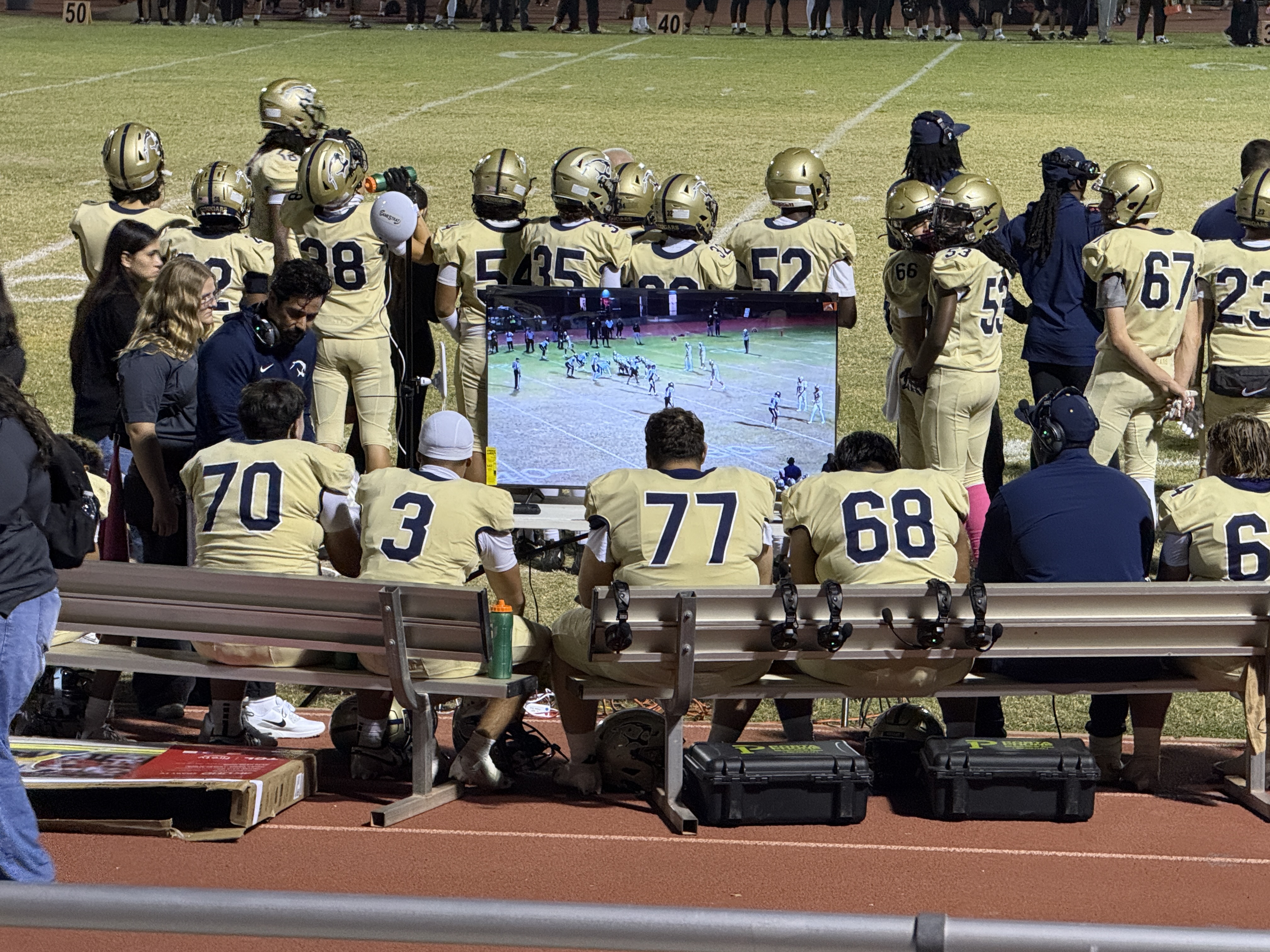
At Raymond S. Kellis High School, benches on the sidelines come equipped with a 50-inch flat screen television that constantly rolls game video.
“We can see plays in real time and make corrections, not even in a play but within a series of plays,” Kellis coach Chris Miranda said.
Kellis uses GameStrat, a sideline video replay system that synchronizes plays from multiple angles and types for coaches. Miranda estimates that Kellis pays around $3,000 for a three-year deal, most of which comes from various team fundraisers.
Miranda and his coordinators are constantly holding iPads with game video, immediately following play breakdowns after drives.
“I feel like the iPads help,” quarterback Brodee Lermon said. “They can fix everyone’s mistakes on the sidelines. We try to prevent those from happening again.”
Lermon pointed out a breakthrough in their loss against Desert Edge on October 24.
“We were throwing bubble screens, and the whole time (Desert Edge) was starting to key down on them,” Lermon said. “We went to the sidelines and made an adjustment.”
On the ensuing drive, facing a third down and long, Lermon extended the play to find an open Lamin-Jo Conteh down the sidelines and between the pressed secondary for a touchdown. It was his second career reception.
“The adjustments really help the smaller names shine,” receiver Ricky Wilson said.
Miranda has seen sideline technology rapidly adapt since his time as a receiver in the mid-2000s. As a player-turned-coordinator at Peoria High School, Miranda was a part of the film evolution and trickle-down wave from the NFL and college football’s scouting advancements.
“The headsets were the first real tech wave,” Miranda said. “Coaches communicated from up in the booth to down on the field, so you get your playcallers or ‘eyes in the skies’ up there.”
“We used to take photos,” Miranda said. “Between quarters, you would get your slips of the defenses and offenses and what they saw. It just evolved from there.”
Miranda estimates the headsets, iPads, television and other technology cost a few thousand dollars, but didn’t immediately have an exact figure.
Despite the heavy use of technology, coach and quarterback communication remains simple. Between plays, Lermon usually follows hand signals from various offensive coaches, though he said he sometimes runs to the sideline to be fed a certain play.
“The communication works great with me and the sidelines,” Lermon said. “We’re all in sync.”
Miranda said he plans to push technology and film reviewing further with Kellis.
“There are protective cases and renewed headsets and new iPads we all have set on our future,” Miranda said. “We plan to keep every step with the modern age.”